23 Amazing Croatia Landmarks Worth Booking A Trip To See
Croatia is the perfect travel destination if you’re looking for a mix of historical landmarks and stunning natural scenery.
If you are looking for a holiday destination with lots to see and do, then Croatia should be at the top of your list!
From Dubrovnik’s medieval city walls to Plitvice Lakes National Park’s thundering waterfalls, ancient monasteries, and towering castles, there are plenty of Croatian landmarks to see, and they’re some of Europe’s best.
Here are some of the country’s most famous landmarks and historical sights.
1. Most Famous Croatia Landmarks

Croatia is a stunning nation with many interesting sites to see. There is something for everyone to enjoy, from the magnificent beaches of Dubrovnik to the commanding walls of Fort Lovrijenac.
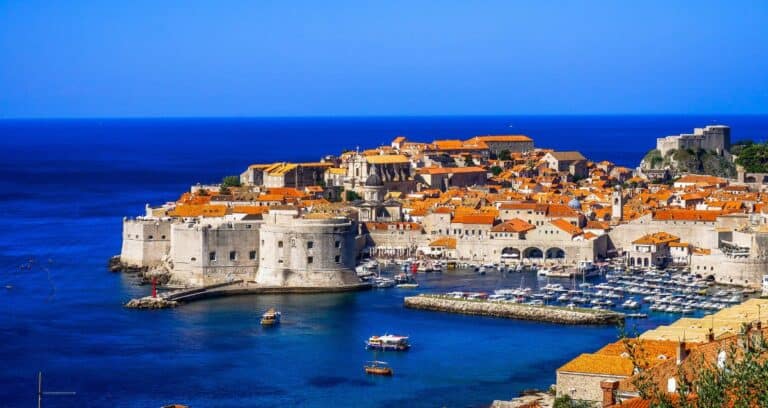
The Old Town of Dubrovnik is a UNESCO World Heritage Site and one of the most well-liked tourist locations. This picturesque town is full of historic buildings and winding streets, offering breathtaking views of the Adriatic Sea.
Another famous landmark is Zlatni Rat Beach, known for its unique shape and turquoise waters.
Enjoy hiking through Krk National Park or exploring the Roman ruins of Salona. No matter your interests, you will find impressive landmarks to explore in Croatia.
2. Dubrovnik Old Town

Dubrovnik is a southern coastal city and the most attractive Croatia landmark. Its extensive history and well-preserved buildings have made it a popular tourist destination. In 1979, the old town was declared a UNESCO World Heritage Site.
The city walls are almost 2 km long and were built in the 11th and 12th centuries, which is a point of interest. Other notable landmarks include Rector’s Palace, Franciscan Monastery, and Dubrovnik Cathedral.
Visitors can also take a cable car to Mount Srđ, which offers stunning views of the city and its surroundings.
3. Zlatni Rat Beach
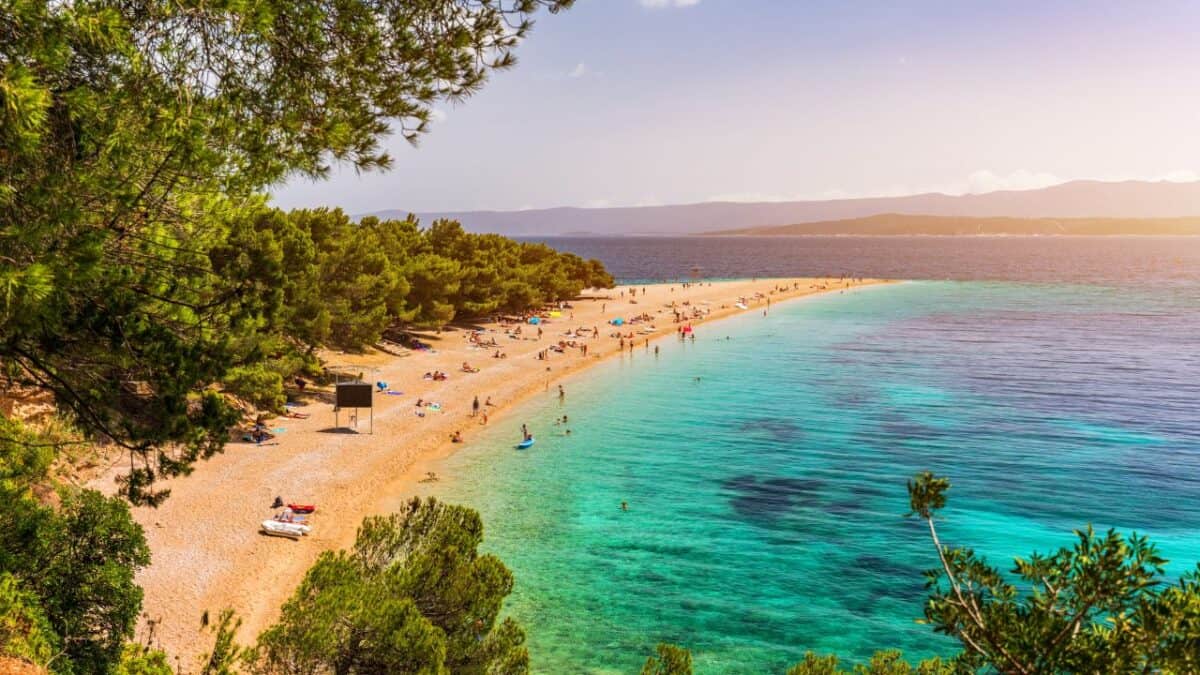
Zlatni Rat Beach is one of the most famous landmarks in Croatia. It is located on the island of Brac and is known for its beautiful white sand and crystal-clear water.
Visitors can enjoy swimming, sunbathing, and windsurfing at the beach. Many restaurants and cafes are nearby, making it the perfect place to spend a day in the sun.
4. Krka National Park

Within the Krka National Park, Croatian points of interest include the Skradinski Buk, Visovac, the hiking trail, and locations Stinice—Roški slap—Oziđana cave, Krka monastery, waterfalls, other beaches, and souvenir shops.
The national park is full of animal and plant life, and its connectivity, whether on foot or by bicycle, adds a unique charm to the overall experience. All visitors to the park are allowed to swim in designated places, but disturbing the area’s ecosystem is forbidden.
5. St James Cathedral

St James Cathedral is the most famous cathedral in Croatia. It is located in the city of Šibenik, on the Adriatic coast. The cathedral was built in the 15th century and is considered one of Southern Europe’s finest examples of Renaissance architecture.
The cathedral is known for its unique blend of Gothic and Renaissance styles and beautiful sculptures and reliefs. It is a UNESCO World Heritage Site and one of the most famous landmarks in Croatia.
6. Plitvice Lakes National Park

Plitvice Lakes National Park is Croatia’s most popular attraction, attracting many visitors year-round. It was declared the country’s first National Park in 1949 and has been under UNESCO protection since 1979.
Most of the park is covered with forests, some with grasslands, and only 1% with lakes, which are the most attractive to tourists. As many as 16 of them are home to numerous animal and plant species that can be observed safely.
7. Korčula Town

One of the most famous places on the Dalmatian coast is Korčula Town, on the island of Korčula. The town is known for its Venetian architecture and for being Marco Polo’s birthplace.
There are many things to see and do in Korčula Town, including visiting the old city walls, the Cathedral of St. Mark, and taking a boat ride around the island.
8. Pula Arena

Built in the 1st century, it is one of the oldest monuments in Croatia, and is undoubtedly, one of the most beautiful. In the beginning, it was an arena where gladiators fought. Later, it was used for knight games and fairs. Today, it is used for film festivals, operas, concerts, etc.
The tourist attraction is open throughout the year and attracts admiring glances with its elliptical shape, with an axis as long as 130 meters. It is a miracle of construction in the heart of the city of Pula!
9. Fortica Fortress Španjola

The Venetian-era fortification on the island of Hvar, Fortica, or “Spanjola,” was constructed at the start of the 16th century and renovated in 1579. The fortress now houses a collection of artifacts from antiquity and the Middle Ages, including amphorae.
You will experience an incredible panoramic view, of the town of Hvar, its surroundings, and the Paklin Islands, and witness the original architecture.
10. Salona Roman Ruins

The ancient Salona is hidden in the shade of a town named Solin. It was once the capital of the Roman province of Dalmatia and the largest archaeological park in Croatia. Imposing walls with towers and gates, a forum with temples, an amphitheater, and cemeteries with Salonitan martyrs testify to its greatness.
According to legend, a city with over 60,000 inhabitants and the birthplace of Emperor Diocletian. Wandering through this empire of ruins is an evocative journey into the age of emperors, gladiators, and Christian martyrs.
11. Zagreb Cathedral

One of the most popular historical sights is the Zagreb Cathedral. Built in the 11th century, the cathedral is one of the most important landmarks in Croatia and a popular tourist destination.
The cathedral is located in the city center of Zagreb and is surrounded by many other historical buildings. Visitors can also tour the cathedral inside and see the beautiful architecture and artwork.
12. Fort Lovrijenac

St. Lawrence Fortress is also known as the Gibraltar of Dubrovnik because it dominates the sea landscape. It has a triangular shape with three levels and is 37 meters high.
The fortress was built several times, and Juraj the Dalmatian gave it its present appearance in the 15th century. In just three months, the people of Dubrovnik heard that the Venetians wanted to build their fortress on the rock and thus control Dubrovnik.
The people of Dubrovnik carved the inscription “Non-bene pro toto libertas venditu auro” or, in translation, “Freedom is not for sale, even for all the treasure in this world” on the entrance to the fortress.
13. Sea Organ and Salutation to the Sun

The well-known tourist summer destination is the location of a pretty new attraction. Built only a few years ago, the two are next to each other.
On the Riva, next to the sea itself, you can enjoy the unique “singing” of the sea through the Sea Organ, an impressive staircase designed to create sounds from the impact of waves. Stand next to them, listen to what nature wants to tell you, and relax all your thoughts.
When you’re done, continue to Salute the Sun, the spot from which the best sunrises and sunsets can be seen. Expect big crowds in the summer months.
14. Trakošćan Castle

The most beautiful castle in Croatia, Trakošćan, is surrounded by buildings next to the castle, a lawn, and a park forest, making it an ideal “escape” from the city centers into a beautiful natural environment.
It was created at the end of the 13th century as part of the defense system. Today, it is owned by the state, which, through the museum inside, informs visitors about its historical importance.
Its corridors and furniture, designed and preserved, will delight you and present the noble life of that time. The castle consists of a low and a high ground floor and the first and second floors and is open daily for visits.
15. Ilok vineyards

Croatia is full of places that grow local varieties of wine. Some are from the islands of Pelješac, Istria, Zagorje, etc., but, still in the far east, more precisely, in the town of Ilok, their creation provides a unique experience.
With a tradition of 1,800 years, the people of Ilok have perfected their recipe. To learn more, visit the wine cellars of the Ilok Cellar company. Their Traminac, Graševina, White Pinot, Rhine Riesling, and Chardonnay are world-renowned varieties and have won accolades such as Decanter, International Challenge, Citadelles Du Vin, Vianlies Internationales, and many others.
16. Diocletian’s Palace

Diocletian’s Palace is one of the landmarks in Split and exactly what you need for an interesting historical education. It was built around 300 during the Roman Empire for the emperor Diocletian.
It was the emperor’s summer residence and luxurious villa, where he came on vacation with his guards, who watched the surroundings from the watchtowers. It has been on the UNESCO list of World Cultural Heritage sites since 1979.
17. Funicular in Zagreb

The funicular is already an iconic place to discover the city of Zagreb, which connects the Lower and Upper Town.
It is one of the shortest cable railways in the world, only 66 meters long, and is legally protected as it has retained its original appearance and construction. It can accommodate 28 passengers and is open all year round.
18. Osijek Fortress

Osijek offers a handful of attractions to visit including the famous Osijek Fortress. In its history, it was one of the most modern military fortifications built in the Baroque style.
Today, it is an indispensable part of the city offered to tourists and is the best way to start sightseeing.
19. Kopački Rit Nature Park

Kopački Rit is a floodplain created by the action of the Drava and Danube rivers. The terrain is suitable for developing special animal and plant species. The park’s trademark is the beautiful white lilies that “swim” on the water and the Siberian iris, which is extremely rare on European soil.
Birds are the most represented species of animals. As many as 293 of them are found within the park. Storks, herons, ducks, pheasants, and other birds are a natural paradise for those who love them.
20. Krapina Neanderthal Museum

The so-called Krapin proto-human. Homo sapiens neanderthalensis was discovered in 1899, when nearly 1,000 fossil human bones were found, representing one of the largest collections of Neanderthal human bones.
Due to its importance, the museum area is protected as Croatia’s first natural paleontological monument.
21. Rastoke

Locals explain Rastoke as a “game of nature” that involves the waters of Slunjčica, which flow over the rocks into the river Korana, creating many waterfalls, rapids, small lakes, and cascades.
In history, Rastoke was a place where grain was milled and inhabited by peasants, and today, people from all over the world come to witness this unique “game of nature.”
22. Blue Cave Vis

The cave is on the Vis Island, famous for its dramatic cliffs and crystal-clear waters. Visitors can take a boat tour to the cave to see the fantastic blue light that shines through the water. The light is caused by, a combination of sunlight and reflection from the cave’s white sand bottom.
23. Vukovar Memorial Center

In the early nineties of the 20th century, Croatia was engulfed in war, and Vukovar, a city in the far east of the country, was the most affected by it. He defended himself heroically for three months until November 18, 1991, when he fell under the aggressor’s rule.
Later, in the liberation of the entire country, he was also returned under Croatian law, but with significant human and material losses.
In memory of his victim, there is a Memorial Center in the city, with which many Croats have a special relationship.